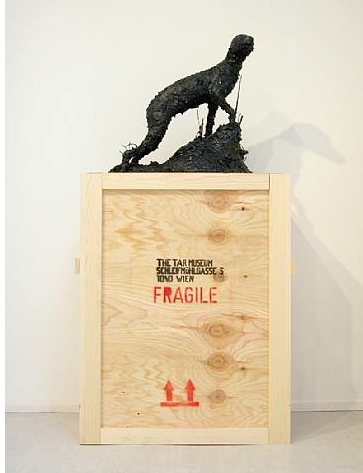
Stuffed Animals and Pickled Heads: The Culture and Evolution of Natural History Museums,
by Stephen T. Asma
The book is a fairly enjoyable, narrative sort of history of museum information, comprising information on science, anatomy, dioramas, displays, art, various important historical figures in the development of the museum, preservation techniques, and major institutions like the Royal Society and the Field Museum. At first, I was a little turned off by the book because I feel like the author writes how I would write this very book (with a little bit of forced humor and some equally forced narrative to drive it along . . . like "I wondered how they prepare specimens, so I went to the museum to find out,") but it's gotten better. :)
In the introduction, he mentions the similarity between science-based museums and art museums. This is a good point, I feel, to keep in mind. . . that this museum exploration bears an important relationship to the way we cordon-off artwork as well.
"The odd thing about a specimen is that it's a kind of cipher when considered in isolation.
Specimens are a lot like words: They don't mean anything unless they're in the context of a sentence or a system, and their meanings are extremely promiscuous." xiii
He clarifies the distinction between a
homology and an
anlalogy in terms of physiology. So a bird's wing and a butterfly are analogous, but derived from similar selection pressures rather than from a common genetic background. Vs. a human hand and whale fin, which does have a homology. I don't know why I felt the need to post-it-note that in the book, but I did.
Somewhere in there, he describes what the embalming process is actually like for normal dead bodies in America, and that completely confirms my desire to be cremated, and to forget everything I read about that so I don't have to associate this incredibly violent procedure with anyone i ever know that passes away.
Apparently, there is a collection of suitcase-shaped diorama cases that the Field Museum used to take around to different schools. "Each of the nine hundred dioramas is housed in a Plexiglass-fronted polished mahogany case, about 23 inches high, 25 inches wide, and 7 inches deep." There are in the "education department" of the museum and educators can apparently still check them out. (32) I should make these! :)
He talks about evolution and how we are good at looking for patterns because those that could recognize patterns of danger left more offspring. (Our ability to simplify things. . . which I talk about in drawing class) 35
"In 1883 William T. Hornaday built one of the first lifelike exhibitions for the National Musuem, one of the first in all of America. The exhibit, called "Battle in the Treetops," displayed two male orangutans in a territorial fight, and it was an early attempt to break away from the dry taxonomic displays that previous curators had arranged for scholarly audience. Hornaday folowed up this popular success in 1888 with his "American Buffalo Group." . . . I just love that title, for some reason. (42)
Later it talks about how he went to Montana to gather "authentic materials" and that makes me think of how I should use local soil and rocks or whatever if I do some kind of installation like that.
Field musuem is named after Marshall Field, btw. I guess I should have known that.
68 - talks about one method of preparing a specimen in which
"Animals were relieved of their viscera, blown into three-dimensional balloons, and shellacked for display." BALLOON ANIMALS. I love this. Can I make this? :)
OK-- several months after first posting this (03.08.2011), I stumbled upon the exact realization of this idea.
Hanging animals from the rafters! A whole room of animals dangling from the sky becasue there are so many of them? Possibilities.
Robert Boyle (of Boyle's law) was involved with the revolution created by the microscope and understanding crystalline structures, stuff like that, so he wrote a book that I just love the title of: "The Origins of Forms and Qualities" which revealed the underly microstructures of everyday objects. I think that would be such a great name for a show about evolution and visual things and animal and . . . yeah. (73)
"If science be manifestly incomplete, and yet of the highest importance, it would surely be most unwise to restrain inquiry, conducted on just principles, even when the immediate practical utility of it was not visible. In mathematics, chemistry, and every branch of natural philosophy, how many are the inquiries necessary for their improvement and completion, which, taken separately, do not appear to lead to any specifically advantageous purpose; how many useful inventions, and how much valuable and improving knowledge would have been lost, if a rational curiosity and a love of information had not generally been allowed to be a sufficient motive for the search after truth." -- Thomas Malthus (1776-1834) - quoted on p. 81
Here is a beautiful and lovely and wonderful Latin phrase: "Pulvis et umbra sumus" = "
We are dust and shadow." I LOVE THIS. It was used in some morality play things (like a plackard held by skeletons). (92)
Ok. How great is this:
"Aldrovandi's book on chickens includes a chapter entitled, "Concerning Freak Chickens" where in he sets for credible embryological abberations . . . At one point, he states, "If any bird should be called a freak, it must be the rooster which I observed a few years ago, when it was alive, in the palace of the Most Serene Grand Duke Francesco Medici of Tuscany; it struck fear into brave men with its terrifying aspect." This conjures up a wonderful image of burly grown men trembling in the presence of the dread chicken of Tuscany." !! (93)
end there temporarily ----
101
"Remember that the cosmos were understood, at this time, as a giant machine.
Clocks were a favorite metaphor of the day. If clocks have thier orderly structure because intelligent minds have designed and built them, then the clock itself is a kind of proof of a designing mind. By analogy, the orderly cosmos is evidence for a designing God."
In talking about evidence of evolution, he says "Next, the existence of seemingly useless organs and structures is unintelligible without evolution, but quite coherent with it. Wisdom teeth and the appendix are well-worn examples of structures that served a function in prehuman history, but some lesser-known cases include the useless femer and pelvis in whales (indicating their terrestrial quadruped ancestors), a similarly useless pelvis and femur structure hidden within the bodies of primitive snakes such as boa constrictors (indicating that snakes evolved from four-footed lizards . . . etc." 161
167 "Of course, there is no real acme to evolution. Evolution is not progressive, because the idea of 'success' or 'better' is completely relative to enviroment rather than absolute." (in this context, he talks about an exhibit in France that is actually pretty funny where it shows a progression of skulls, culminating in DesCartes (the top is a Frenchman! :)) and then having a box where you can see yourself in a mirror to see that evolution affects you too. :)
171 Recounts a museum display that has benches (part of the Grande Galerie de l'evolution in Paris) that holds "retractable plexiglass slates of scientific information" in the benches. Interesting.
172 He talks about how man's destruction of nature is a nearly constant part of today's moral rhetoric of the museum saying "When you start out, you read the bench slate: "Relations between man and nature: Human activity has transformed the evolution of the natural world, causing rapid, profound, and sometimes irreversible modifications to the environment." This really translates to "Tour the astoundingly many ways that humans rape the planet and find new and interesting reasons to loathe yourself and your species." :) He goes on to mention some dioramas that I should perhaps look at "Like Fredrick Ruysch's dioramas, which called upon his eighteenth-century audience to repent their sins. . . " etc.
Great sentence about the goal of museums, and perhaps dare I say the goal of art things as well: "No curator believes that patrons will drop to their knees in moral epiphany. Moral sentiments will not suddenly materialize where there previously were none. But dormant moral sentiments (of responsibility, duty, guilt, compassion) can be rekindled by such museological rhetoric, and exhibit imagery can play a powerful role in this mission." 172
"tiny replica of our planet" -- like a jewel. Like a pin top. Like Carl Sagan's pale blue dot. (talking about a room at the end of the Paris museum dispaly I think. It's a circular room with an "intense beam of light strikes the tiny orb" and there is new age music so he says its too melodramatic and funny.
He describes the whole experience of walking through the Paris gallerie of evolution exhibit, which is multiple floors and sounds really amazing. He actually spends an entire chapter, called "Exhibiting Evolution" comparing and contrasting I think three major exhibits of evolution. It's really great -- easily the best chapter in the book. It gives a lot of ideas for how to present things, but also what those kinds of decisions mean, or the ways that one idea can be so differently expressed through emphasis and omition. In the future, it might be useful to re-read and photocopy this entire chapter. :)
Anyway, on 174, he's talking about how the whole space gets darker with fake lightning and rainstorm sounds ("it's how a thunderstorm would be if nature were managed by Cirque de Soleil") . . . which sounds cool, and then goes on to describe "small diorama chambers built into the walls" that he describes as "historical chapters" . . . I like this idea of building them into the walls. He also relates how there is a portion of the exhibit that is repeated later in the museum, and that the first time it is just a collection of odd things, but later it is presented with context and explanation. So this idea of introducing something and repeating it later. I like it.
He discusses the organization -- starting with the "oceanic environment of level 1" he describes all kinds of floating fish and cetaceans. He says it starts with this open-water thing, so they are all suspended from the ceiling with nothing below but open ocean. And then it moves into shallower water, etc. and eventually opens up onto this plain of mammals. He then talks about the way that space is used to convey information "For example, in the display windows of the abyssal zone, the specimens are placed very far apart from each other. These relatively sparse cabinets (almost empty) are visual representations of the rarity of life in these regions." 176 and describes this as a non-discursive format. Good point.
He contrasts all of this with the New York American Musuem of Natural History and it's emphasis on taxonomy. "it wants its patrons to appreciate the order of nature." But, unlike some exhibits which are arranged temporally, this one is arranged by primitive animals and more complex ones, which does not mean that it goes from extinct to living. For instance, contemporary sharks are right at the beginning, because they are primitive animals event hough they are still alive. So it's a "primitive to advanced" organization. He says this has to do with the cladistic approach to taxonomy, which I do not fully understand even though I spends a fair bit of time discussing it. (This is actually the most rigorous part of the book, I think --this chapter--which I think is part of why its good. I complained about the beginning being too dependent on trying to make an interesting narrative, but this part is actually really intellectually intriguing).
He explains how and evolutionary taxonomy is different from other "artificial" taxonomies because you aren't grouping things by certain priviledged characteristics, you are grouping by picking out "temporally and spatially extended individuals." 186 "Reconstructing a historical narrative is not entirely objective, but such a narrative does not try to group events together because they have outwardly similar features. It groups them together because earlier ones gave rise to specific later ones. . . " He says that people try to claim that evolutionary taxonomy is the same as other arbitrary designations, but he thinks it isn't. (contrasts it as geneological vs. other internally consistent systems.)
". . . scientists are not, and have never been, theory-free spectators; they can't be, because without expectations or background beliefs or assumptions, every one of their sensory experiences would be equally significant--which means that the experiences would be equally insignificant." 189
190 "
Relativism is an inflammatory word, and scientists get nervous around it because it is often used as a synonym for "fabricated truths" or "subjective ideology." Some humanities scholars have chosen to reconceptualize the sciences (and their findings) from the uncontrained perspective of literary criticism. Everything is a text. Everything is political." this sounds familiar to me. Further, though, "If we can move beyond this draconian version of relativism (and for the still-bristling scientific community, this will probably take awhile), we can actually see a deeper strata of healthy relativism. He describes how many taxonomists still think they are making maps of reality, but they acknowledge that different mappings can be accurate (so there are really lots of different taxonomies that end up being useful for different kinds of studies).
He points out an interesting backstory about Darwin and how he is so highlighted in the London exhibit but barely mentioned in the French one. He illuminates this to be more than just a matter of national pride, to explain that it goes to a debate on natural selection vs. mutation as which is the more important "mechanism of transformation." The French felt that mutation was more important, and saw Darwin as merely building on already established ideas of mutation that the French had established long before. (Darwin exhibit doesn't mention any of his intellectual predecessors). Anyway, the way the French thought of it, change was possible within an individual (very quickly) rather than the long-term, slow change of natural selection. They saw natural selection as too brutal and lawless, or chaotic, and adopted a more "optimistic" idea of individual response. So they highlight mutation rather than environmental effects. Interesting (and interesting in the way that this kind of relates to the whole fundamental attribution error. :) I think anyway . . . ) 199
209 - talks about distaste for randomness.
Scientific dislike of randomness is "everything happens from a cause" ("events are not un-caused") and a moral dislike of randomness says "everything happens for a reason" . . . which is interesting. But I also like that maybe the idea of randomness is a good way to invert or subvert the traditional means of museum display or scientific perspective?
210 He traces the resistance to evolution back to this fear of being like animals, being "mere" animals, and he says that this fear goes back to Plato. "If we are just material creatures, without a spiritual infusion, are we free?"
211 More on why Pope JPII was weirdly progressive: "In the late 1900's, a few years after he apologized to Galileo, Pope John Paul II delivered a written message . . . stating that the Catholic Church formally recognizes the truth of evolutionary theory." There are, I'm sure, nuances to this, or provisions. But there you go.
Here is something amazing. There is a "humorous interactive display" in the Field Museum (or was anyway) in the "life Over Time" exhibit called
"Happy Birthday Homo sapiens in which you can place your head in a hole in a wall and find that you are looking into a big mirror with a reflection of a mural of a bunch of apes and pre-humans with cake and a table. I LOVE THIS. I could also build something that you look in that way . . . Hmmm.
"The upshot of all this is that I end up playing an editorial role, always starting with way too much content and editing down and editing down and editing down and seeing what's left. Someday I'd like to do an exhibit where you start with some basic ideas and basic rules, and then you build that to the appropriate level starting from nothing, more or less. Rather than starting with everything and editing down, I'd like to build up from basically where visitors are starting, which is with some very basic ideas that they might remember from school and newspapers and TV." Eric Gyllenthal from the Field Museum, interviewed by the author. This sounds like an interesting idea. 230
Also, I should say that all the description of the way exhibits are designed and put together -- this team activity of working on a project to convey information to people -- sound unbelievably fun, and I suspect that I might be happy being an exhibit designer.
In talking about museums, he says ". . . there has been a continuous dialog between image-making activities and knowledge-producing activities. Unlike texts, natural history museums are inherently aesthetic representations of science in particular and conceptual ideas in general. . . one begins to see that a display's potential for education and transformation is largely a function of its artistic, non-discursive character." 240
Francis Bacon apparently described art as "feigned knowledge" which is fascinating. In my case, it might be true. But it is also an alternative way of knowing.
A story that might be interesting to look at in the future is Jan Van Rymsdyk, who illustrated all kinds of things alongside the Hunter Brothers, but whose "life and death are shrouded in mystery" . . . .
Illustrated one book called "The Natural History of Teeth" which is just great. Isn't it? . . . he also wrote (or maybe his dad did?) a book that they called a "museum on paper" that was unapologetically random. Here is a page of "exhibits" composed as tables:
"A brass spear-head from scotland . . . arrow heads, another with 15 different ova or eggs, "table VI contains, among other things, a spanish dagger" another "different spider nests", another "a brick from the tower of babel" another "illustrates all manner of gambling dice" and another "Lachrymatories, or tear vials, to contain the tears of weeping friends, and which are buried with the dead." 231 This has the charm of the old Chinese encyclopedia, or maybe even the Cress taxidermy museum.
He talks about how museums are extremely associational -- that, "perceiving a causal connection between things is really just acknowledging the most routine of impressions. So, according to Hume, the very best of human knowledge (science, as an example) and the very worst of human knowledge (prejudice) originate from fundamentally the same process." 258 I thought that was a really interesting and compelling sentence.
263 - gives some examples of humor used to appeal to modern, critical and ironic audiences, including one that shows a tiny person and says "homo sapiens : model (not actual size)" :)
Finally, a couple of books he recommends at the end that I might want to read:
Museums and the Shaping of Knowledge, the Poetics and Politics of Museum Display, Museums, Objects, and Collections: A cultural study, and Objects of Knowledge